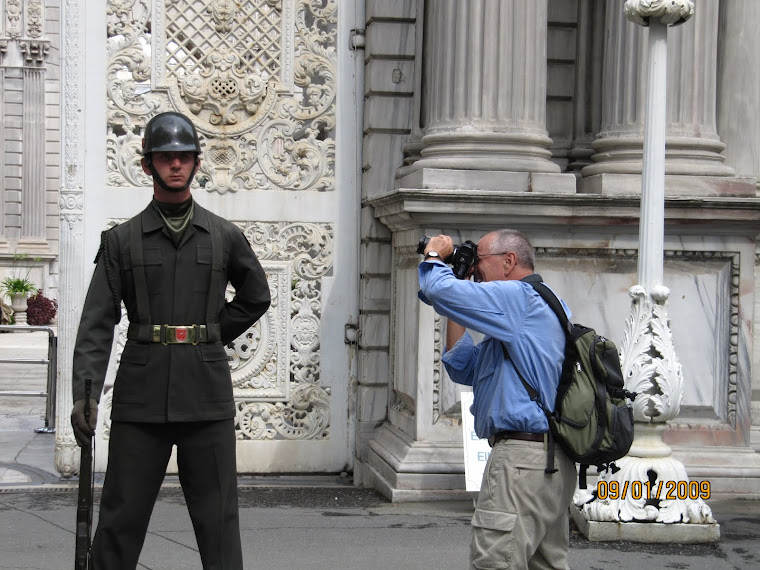
Tall guard in Istanbul

Tall guard in Istanbul
Deciding which camera to pack for my trip. Bulk, quality, weight vs convenience.

Thursday, February 24, 2011

Life on the Mekong

"Shoving off" and "watching the world go by" have literal meaning here!  Left the Gateway Villa Hotel where I had been staying in Huay Xai for the two day slow boat trip to Pak Beng and Luang Prabang.  Bid my friends goodby, shared a tuk tuk to the dock with a German couple, bought my ticket and played petanque with a fellow passenger while waiting for departure.  My fear that this would be some kind of party boat did not materialize.  The potential party crowd found their place on the bow; smoked, drank, sang and did not move!   Everyone brought food and drinks aboard for the 8 hour trip to Pak Beng so they would not have to purchase the more expensive offerings on board.  As someone who has always had his nose pressed against the windows of trains and planes in order not to miss any of the sights, it is hard to understand how some people can read, sleep, listen to ipods or chat for the entire trip without appreciating the amazing scenery.  This long, narrow, flat bottomed boat is controlled by a pilot in the front.  The wheel is connected to a small rudder in the rear by means of chains threaded through PVC pipe above the windows and the very rudimentary throttle has a small cable running to the diesel engine in the rear. A glance into the engine compartment gave me comfort as it had been blessed with flower offerings and a small Buddha.    Relax, take photos, eat and enjoy!  
Day two-  After spending the night in Pak Beng, the village full of guest houses that is midway between Huay Xai and Luang Prabang, it is time to continue down stream.  Taking advantage of the swift current, the boat slips into the middle of the Mekong, gliding between steep ridges covered with tropical vegetation, occasionally old forest, but more often low trees or cultivated patches that have replaced the original jungle. Jagged rock outcropping line the banks, extending into the river at sharp angles and creating brief areas of rapids.  Since it is the dry season, the river is low and the boat scraped bottom on several occasions.    Bamboo poles extend from the rock formations, supports for fishing nets of fishermen who live in nearby villages.  Beautiful sandbanks with multiple water lines resembling stairs have accumulated between the rock formations providing variety to the landscape, playgrounds for children, warm resting spots for clusters of water buffalo and an easy place to grow peanuts at this time of year.  They also serve as a reminder of the water level during the rainy season, perhaps 30 feet higher than today in the narrowest places.  The surface of the river glistens; silver and gold ripples masking the murkey brown green of the water.  Mountain ridges, four to six deep, continually appear before us and slowly fade into the distance behind the boat.  Many people pan for gold in small inlets, others fish from rocks using weighted throw nets.  Long, slender wooden boats moored at the river's edge indicate the presence of villages hidden in the trees.  Seated near the front of the boat, all I hear is the low, steady drone of the engine and  light splash of water along the bow.  Slow boats heading north pass making the same sound, but an occasional "fast" boat, a small banana shaped boat carrying 8 passengers wearing crash helmets, creates a slight turbulance as it roars past.  We stopped several times to allow villagers to jump onto the beach where they were greeted by family or friends.  For two days, life proceeded at the pace of the Mekong current.
Relaxing in Laos, and loving it!

Friday, February 11, 2011

Adventure in Laos

Lots has happened since my last entry; however, I decided a quick jump forward was necessary to capture events of the last few days.

Left Thailand, crossed the Mekong River on a small wooden boat and landed in Houeixai, a small river port in Laos where I intended to spend one night before continuing on a two day "slow boat" trip to Louang Probang.   All of that changed when I read a notice announcing an evening campfire at the home of a family beginning a project to help village people, and that they needed volunteers.  Dinner and a campfire has turned into a week of tutoring English several hours each day and invitations from students working at my hotel to visit their villages and meet their English teachers at the local college.  When one student took me to the college on his motorbike, I ended up teaching two classes and met three of the five teachers.   I have a standing invitation to return. This evening I have been encouraged to attend a celebration at the local Buddhist temple, a farewell dinner for the couple that has been volunteering at the project, and have more invitations for the weekend. I am certainly learning more about Laos and Lao culture by interacting with locals here than if I were to simply photograph more temples, Buddhas and street scenes.

Yesterday the family operating the volunteer project planned an outing for the French couple, Igor and Veronique, who were married recently and who are on a one year, around the world honeymoon, and me. We rode on motorbikes behind three of the men in the family to a village 70 kilometers from this river port and had an experience we will never forget!   First of all, these are small motorbikes meant to be ridden on city streets rather than treks in the mountains.   I rented an additional bike since the family had two vehicles and only foreigners are allowed to rent bikes.  Lao time means that things happen slowly, so we left the house about 10:30 am, all wearing helmets, two of us carrying small backpacks with cameras and a few snacks, and began the adventure.   I immediately thought of the Beta Theta Pi principle of "confidence and trust" as the bikes went screaming around turns and raced out of the town.   I could not worry about what might happen this day, must believe that the driver in front of me knew what he was doing, and just enjoy the experience.  I hung on for dear life, anticipating the corners and bracing myself for bumps in the road.  The pavement ended about 15 kilometers from town, the speed barely slowed, and the serious challenge began.   Unimproved mountain roads, single lane, torturous curves, steep inclines- one indicated at 15%- loose gravel, dust, all combined for a wild ride.   These people begin riding motorbikes at about age 10, and most of them on this type of road, so it is not a new experience for them.  Once we left the paved road, we began climbing into mountainous terrain, ascending ridges, descending into valleys, one after another, occasionally passing through local villages where children, chickens, dogs cows and even water buffalo quickly stepped aside as they heard our approaching bikes.  I must admit that the landscape was spectacular, especially the views from the ridgetops where a succession of  ridges resembled the surface of a giant blue cauliflower.  Tall trees have been removed from much of the area and only here and there stands of original timber still remain.  Otherwise a few old trees rise above a tangle of bamboo, vines and smaller varieties of trees, all of this seemingly inpenetratable. 
We stopped briefly in several villages to contemplate the houses, usually standing on  stilt like frames built of wood, sometimes with wooden slat walls, but more often sided with sections of woven bamboo.  The common roofing material is woven grass and only a few buildings have corregated steel or fiberglass.   We stopped for lunch at a roadside stand at the side of a house where the lady had a black pot setting over a small fire.  She prepared noodles for us and offered a soup with chunks of a glutenous substance made from rice.   Several times we had to chase the chickens away from the area where she was preparing the food!  Not an unusual occurance here.   Around villages situated in the valleys and along streams, small plots of rice are cultivated during the rainy season.
The final destination and experience had been a well guarded secret so we wondered what was in store when it was necessary to buy candles and obtain a few flashlights at the last village.   Four local girls were hired as guides and we discovered we were to explore a nearby cave complex.   Spelunking had not been on my list of things to do in Laos!    The setting was spectacular as we left the store, walked past the small primary school where laundry, colorful childrens clothing, was draped over the fence enclosing the playground (we speculated that they might wash their clothes during recess), waded across a stream and begain winding our way through bright green rice paddies.  Our destination, large rounded, rocky mound rose from the valley floor, surrounded by a maze of recently planted, and currently flooded, paddies.  Here and there small thatched roof shelters built on bamboo stilts provide shade for those working in the rice fields.  We zigzagged our way along the narrow muddy dikes separating the patches of rice, jumping small streams flowing from one section to another.   I wondered why I had bothered to take off my shoes to ford the stream at the beginning as it was obvious my shoes were going to be very muddy and wet for the return trip.  During colonial times, the French had built a concrete stairway to one cave entrance, but that did not lead to the main network of tunnels.  We continued to another entrance where it was necessary to wedge our way through a slot barely wide enough to allow passage for our shoulders and derriere.   Once inside, the space was larger, we lit the candles, let our eyes adjust to the darkness and began our exploration.  This chunk of mountain was perforated with holes eroded over the millenia and gave us the impression of having entered a giant wheel of Swiss cheese.  An occasional opening above allowed some light to enter from outside; however most of the rooms were only illuminated by the dim light of our candles and flashlights.  Bamboo ladders provided access to some levels that would otherwise have been inaccessible.   Finally, in the far reaches of this complex, there was evidence long term moisture, perhaps tens of millions of years ago.  Seams in the rock showed evidence of mineral deposits, flowing limestone stalagtites and mounded stalagmites where the water droplets had landed.  One giant post about 15 feet high and  several feet in diameter must have taken millions of years to accumulate.  The top surface of another looked like an enormous stone stump whose unique surface looked as though it had been eaten by worms.   Strange dark spots that we thought at first might be bats dotted the top of several high caverns.   We spent more than an hour investigating sections of this massive complex, trying to capture some of the beauty in photos and speculating at the origin of this natural wonder.  At the exit high on the side of the mountain, we had a stunning view of the surrounding rice fields and a small village at the base of a forest ridge, all bathed in the solf light of late afternoon.   Finally, deciding that we needed to reach paved road before it got dark, we left the cave, retraced our steps through the  beautiful rice paddies, waded  the stream- wearing shoes this time- paid the guides and began the return trip.  The lighting was perfect for photography, but we knew that not many stops would be possible.   A flat tire required me to wait along the side of the mountain road for about 20 minutes while my driver returned to see what was keeping the third bike from catching up.  Alone, I listened to the cracking sounds of a tropical forest, took photos of the  bamboo branches curving over the narrow road, nodded to a few people who passed on bikes and to the drivers of a truck that passed and greeted two men walking home from their day's work, axes in hand, not knowing  what was happening or when my driver would return.  Tire repaired thanks to a nearby village, we continued on our way, passing a slow moving logging truck carrying 4 huge logs cut from an ancient tree, carefully descended some of the steep rocky slopes because only the rear brake was working, occasionally coasted to conserve gas, passed workers returning to their villages slowly advancing in their garden tracter like vehicles, speeded on the straightaways to gain time.  In each village, dinner was being prepared  in pots boiling over small fires along the road or near entrances to houses and people were returning home from their work in the fields or forest.  Igor, Vero and I exchanged our thoughts about our ride at each stop, wondering what the next segment would be like.   Crossing the last wooden bridge, we arrived at paved road, achieved higher speeds and raced through the darkness for home.  When I got off the motorbike, I could hardly move and felt as though I had spent the day on a horse or camel.  Can you get bowed legs from riding a bike? 
We were all in agreement that it was a unique and memorable experience, but were not sure that it was one we would want to repeat anytime soon.

Safe and sound in Laos.     Jon

Thursday, January 27, 2011

Losing track of time- India and now Thailand

Has it really been three weeks since I last composed an entry!?  Since it is not possible to relate everything I have done, consider these exerpts or highlights from my adventures.

Escape Mumbai by plane.  Passed through the dense brown haze and smog at about 20,000 feet and finally saw blue sky.   Burning trash, polluting vehicles and too many people all contribute to the constant layer of particulates that covers the city.   If there is a reward, it is the few minutes in the evening when the sun, a giant red ball, disappears over the bay and the string of lights called the "Queen's necklace"  illuminate the promenade  along the waterfront.  Mumbai, in spite of its challenges, can provide experiences to last a lifetime, even during a brief visit.  I replaced  my plans at the last minute from a foray to the south to a flight north to Jaipur.  A couchsurfing host responded to my appeal and how could I pass up someone with the same name as a famous golfer, Vijay Singh!  Although I stayed with Ankur Sharma and his family, I was really hosted by he and his two best friends, all in their twenties.   The village where I stayed, Amer, is about 10 miles from Jaipur and has one of the region's most famous attractions, a beautiful castle, a fort and stone walls snaking their way over the surrounding hillsides in the style of the Great Wall of China.  Ankur gave up his bed and bedroom so I could be part of the family; mom, dad, 2 sisters, one brother, Ankur and me!   Tea with milk for breakfast, rice with a vegetable sauce for lunch and a similar meal for dinner, all accompanied by freshly made flat bread or nam.   The cast system is alive and well in India- Ankur and his family are Brahman, his friend Abhay is of the same cast and his family are the priests in charge of the largest and most historic temple of the village, and Vijay who is Rajistani has other obligations and traditions.  Each morning, Ankur went to the temple, usually before I got up, and then came to his room to pray before his personal alter.   He answered many of my questions about Hinduism and I shared trips to the temple.  Other than local excursions, walks on the surrounding walls, a tour of the palace, visits to an astounding observatory created hundreds of years ago in Jaipur, trips to the market and time on the roof watching children fly kites in preparation for the kite festival that I would miss by one day, the experience that is most vivid is a trip to see the Taj Mahal!
I had not planned to go to Agra since it was about 4 hours from Amer, but Vijay saw this as an opportunity for an outing with his friends.  He borrowed his uncle's car, I paid for the gas, and the four of us headed to the Taj Mahal.   Originally planning to share driving responsibilities on a divided highway, I soon changed my mind.  Divided highway yes, but that has a different meaning in India.  There is no limited access, so you share the road with camel carts full of short logs or bulging with giant bags of hay that obscure the roadway, buses in various stages of disrepair and trucks- yes, fully loaded trucks coming directly at you on the wrong side of the highway!!!!    It was an exhausting experience for both driver and passengers, but we managed to survive.  Honking is a national pasttime.  It took all day to drive the 150 miles, so we arrived just as the last tickets were being sold to enter the Taj Mahal complex; closing in 10 minutes!  We paid for a tuk tuk to get from the parking lot to the ticket booths, changed vehicles when the first one wouldn't start, had a guide who rushed us to the booth, paid another person to insert us at the head of the line, bypassing at least 200 people, and then ran for the entrance arch to take photos before sunset.    Worth the effort?  Yes!  It was one of those breathtaking experiences, unexpected beauty in a park like setting.   The sun was low in the sky, a slight misty haze filtered the sunlight and out came the cameras.   Even though it was crowded, I think there were fewer people than earlier in the day.  Reflecting ponds mirror the symetrical architecture of this amazingly beautiful white building.   We agreed on a meeting place and I was off to capture the atmosphere of this world class wonder.   Find the perfect angle, adjust the lighting, fight for position with other photographers, enter the mosque at the side in order to frame it through a doorway and then hurry to the end of the queue of people entering the building.   Daylight is fading, there are no lights inside, be pushed by the crowd,  stumble on the raised steps, follow someone with a lighted cell phone, give up on taking photos of the interior  and find the exit.  The post card photos of the inside confirm that I really did not miss the best part of the Taj Mahal.   Sunset, fading light, a few last photos and taking one last glance over our shoulders, we are among the last visitors to leave.
Where to spend the night?   Ask for directions, find a cheap guest house and then get something to eat . We parked while Ankur and Abhay wandered the streets near the railway station to find a suitable place.  When they returned, we found out there is an additional cast in India, the foreign tourist.   I was not allowed to spend the night in a guest house, and none of them was allowed to share a room in a hotel with me; result, they checked me into the inexpensive hotel room before going around the corner to their guest house.  We then met at the "cafe" in front of the hotel for something to eat.  The weather is cooler in the north of India than in Mumbai and none of us was prepared for the cold night.   I slept in my clothes and piled the three available blankets on top of me.  Even then, I didn't get a good nights sleep because I was freezing. 
At 8:00 am, my three friends knocked on the door, entered wearing hoods, hats and all of the clothes they had brought, we ordered hot tea delivered to the room and all crawled under the covers to watch TV while we warmed up.  The crazy photo taken by the delivery boy will be a treasured memory.   The Monday morning traffic was slightly less hectic than what we experienced on Sunday, but we did meet trucks on the wrong side of the highway once again and plenty of camel carts.  My three new friends continue to call me "dada" (grandpa) and to me they have become "beta" (grandsons)!  We all agreed that we had shared a unique and memorable experience.   Ah, this is India.

Arrival in Hong Kong.  At the airport information booth, I met a young man from the UK who had just experienced India and the countries I was about to visit.  With the smell of India still in our clothes, we bonded immediately.  He had a general neighborhood in mind for finding a cheap guest house and since I had made no previous plans, we figured out transportation to the center of the city and to the guest house where we ended up getting rooms. You wouldn't believe this massive, complicated building and the variety of things it housed.  Only describable in person.   Stephen and I shared the Hong Kong experience.   I later spent two nights couchsurfing with Ian, another young Englishman who is teaching in Hong Kong, and he showed Stephen and me places we had not yet visited.  Hong Kong, what a contrast to Mumbai.  Clean, efficient and organized, we were able to get everywhere either on foot or by using public transportation.  I had no preconeived notion of what Hong Kong would be like, and had only considered it a stop over on my way to Thailand.  What a pleasant surprise- a little bit of San Francisco, New York, Cape Town, Istanbul.   We never ran out of things to do and interesting places to visit.  One day we walked the city for fourteen hours, almost non-stop, including climbing long stairways, the steep winding streets leading to the observation areas above the city, taking the longest complex of escalators in the world, and descending in a cable car that sometimes hits a 45 degree angle.   It was absolutely spectacular looking down on the mass of high rise building clustered around the busy waterways.  We lingered in a traditional  neighborhood full of street markets and watched live fish swimming in tanks become still breathing segments on a well worn chopping block and attempted to identify strange looking and smelling foods displayed everywhere.  There is the challenge of ordering food  when everything is written in Chinese and  no photos- we just pointed to something identifyable on a neighboring table and laughed with the locals who tried to assist us.  All of this is just down the street from gigantic modern shopping centers filled with designer shops, Prada, Chanel, Louis Vuiton, Versace and surrounded by banks and investment firms known around the world.  Money!  there must be lots of it here.  Rich Chinese from the mainland come here to shop.   For a contrast, we sought the calm and isolation of Lamma Island; a short ferry ride and a world away from the bustle of the city center.   A fishing village with leaning houses built on stilts, trails leading to isolated and deserted beaches, pathways ending at mountain shrines and small restaurants displaying live lobsters, crab and fish in tanks near the entrance.   Only the passing of huge ships loaded with containers gave a hint of the 7 million inhabitants living just around the corner.    Farewell Hong Kong, hello Thailand.

Wednesday, January 5, 2011

Bandra Slum - A View from the Bridge

Wed. 5 January 2011 

View from the elevated walkway that leads to the Bandra train station.  There is a slight breeze, but the atmosphere is very hazy, the sky is gray, not blue, the filtered sunlight is warm.   People pass in a continual stream in both directions, even at this mid-afternoon hour.   Below me, and to the rear, four huge pipelines, at least 10 feet in diameter, parallel a dirt pathway that runs between them and an open sewage canal.  Men come and go from the corner behind the public toilet facility, urinating on the trash to avoid paying a few pennies to enter the official outhouse.  On the other side of the canal there is a green patch of grass and low bushes, bisected by dirt pathways where individuals often linger, squatting to defecate, sometimes in the middle of the path!  Is this related to the term "squatter" when applied to unofficial housing sites?  Next to the brush there is a small cultivated area with squares of low green plants, leafy vegetables that will be harvested and sold along the street.  They must be irrigated with water from the stagnant pond next to the toilet areas, the reason salads don't make up any part of my diet at this moment.  Hey kids, be happy you can eat the green things that make their way to the table in America!  Beyond the extension of this elevated walkway are several multi-story office buildings and my small hotel, the Armor Court.  A busy main street separated this area from the Bandra slum quarter, a dense jumble of buildings, most from three to five levels high.  My challenge is how to create an adequate visual of this scene.   The lines I see are like those left on the screen of an etch a sketch after several people have played with it; multiple layers of lines spreading in all directions.   The rooftops form slightly sloped lines; sheets of corregated steel or plywood.   The short vertical lines that are not always perpendicular, create geometric shapes whose names I have forgotten- trapezoids, parallelograms?  various triangles?  These figures outline single room dwellings and workshops where I sometimes spot groups of men seated at sewing machines or cutting patterns for clothing, women preparing dinner, people washing.    Most colorful are the bright blue plastic tarps draped over openings or covering parts of rooftops, adding color to the predominately  gray and brown landscape  dotted with small squares of faded yellow or pink.  Openings are sometimes filled with recycled doors and windows.  Water spews sporadically from pipes extending toward the sewage canal, adding to the already sluggish, stagnant and foul smelling sludge covered with trash.  Drying clothes, an occasional black water tank and an occasional satellite dish decorate the uneven and multi-layered roofs.  To the left of the sewage canal there is a busy bus stop, a dusty playground which serves as a cricket field in the evening ( the ball often ending up in the sewage canal and having to be retrieve with a pole or by throwing rocks to create ripples that propel it to the edge), a small street market and leanto tarps serving as housing.    Between this walkway and the rail station, women scrub their laundry on top of a cement platform that covers the large pipes where they go underground and cook over open fires.  Their living quarters are a kind of row house development of two and three story buildings constructed almost exclusively of sheets of corregated fiberglass and metal- gray, brick red, green and blue.  Access to the upper levels is achieved  by means of steep ladder stairs resting on the ground.  Children, goats and stray dogs share the trash dump that occupies about half of the open space.  The soundtrack to this panoramic scene- a cacaphony of notes eminating from the horns of tuk tuks (three wheeled motorized rickshaws), taxis, buses, trucks and cars, whose impatient drivers have developed the nervous habit of honking, necessary or not.  The shrill whistle of trains stopping in the station for 15-20 seconds to load and unload passengers adds variety to the musical score.

Time to vacate my seat, one of the three plastic chairs provided for pedestrians at the bend of the elevated walkway.  A maintenance worker, dressed in bright orange coveralls, someone I met on my first trip across this pathway, has been seated at my side watching me write this journal entry.  We have a communication problem, but as I rose to leave, he called someone in his family who speaks English, to tell me hello. The information I gained was basic; he is married and has a 3 year old daughter.   His welcoming smile, his handshake and hug, and the fact that he shared the seating space for nearly an hour conveyed his feelings and message.  Welcome to Mumbai.

Saturday, January 1, 2011

Paris: a fifty year love affair!

Lots has happened since my last blog, but currently I have Paris on my mind.   It has been 50 years since my first trip to France and an academic year of study in Paris that changed my life.   How many times have I returned?   I have lost track, but I know that each time I arrive, it is like a homecoming.  In spite of the cold weather, I lost no time filling my schedule with interesting things to do in the "City of Light."   It was unofficial couchsurfing and having the keys to the small apartment of my former student Chris Wolter that made it seem like I was really living there.  Since Chris was still working, I could come and go as I pleased, although leaving in the morning, I rarely went "home" during the day. 
It still amazes me that a city with as many holes as a piece of Swiss cheese functions- the metro, the regional rail system called the RER, the sewers, the catecombs, pedestrian tunnels, underground rivers, all of these tunnel under various parts of the city.   In spite of the efficient and extensive public transportation system, many Parisians insist on driving their cars and are willing to sit in massive traffic jams each day while pedestrians, bikes, scooters and motorcycles keep moving. 
What did I do?  My goal was to view some of the photo exhibits that were  part of the November "mois de la photo."  I went to displays at the Maison europeenne de la photo, the Jeu de Paume Museum, the Museum of Modern Art and the Petit Palais.   Some were exhibits of photo journalism that captured shocking scenes of wars, hunger and other human tragedies that we do not usually see in newspapers and magazines.  The French are much more likely to include these in publications and on TV news than Americans.   Other photos were more artistic in nature.  
My personal photography goal was to find interesting street art and grafitti and to visit locations I had been previously to see how the art had changed.  The areas I visited were Belleville, a working class neighborhood on the Right Bank, the rue Mouffetard, on the Left Bank and the canal d'Ourq, a working class neighborhood on the north edge of the city.   The artists have been busy and I will return with hundreds of interesting photos to edit.  My Beta friend, Robert Ulmstadter, spent one day with me as I showed him many of my favorite parts of Paris, and helped spot grafitti art along the way.  I think he is now "hooked" and will be scanning walls for street art during the rest of his travels.  Early New Year's Day, I left at 8 am to investigate the northern outskirts of Paris.  Seeing a few tags in a parking lot, I soon found an opening to an abandonned freight yard along the canal de l'Ourq and stepped into a veritable living gallery of grafitti.  Street artists had covered all of the exterior walls of this delapidated five story building with a variety of designs, but it was the wall surrounding the area that was most interesting.   The most talented and skilled artists had painted a Halloween series, portraits and geometric designs.   With my fingers numb and not able to change settings on my camera, I decided it was time to return to the apartment, take a warm shower and get ready for the walking lecture visit that we had scheduled for the afternoon.  Beginning at the elegant Place Vendome, location of the Ritz Hotel, fashion houses and the most expensive jewelry boutiques, we walked the neighborhood with a guide who explained architecture, history and personal anecdotes about this historic area.  Two hours later we quickly found a local cafe where we could order a much needed cup of hot coffee.
Then it was off to celebrate the new year!

My favorite walking areas:  everywhere in the Quartier Latin because I love the small streets, numerous art galleries, coffee shops and book stores.  Even if I am not in the market for a new book, I wander through Shakespeare and Company where there are steep stairways, old couches, quiet hidden corners and a view of Notre Dame from the upstairs window; hangout in the 20's of American expats such as Hemingway.  Around the corner is the Hotel Esmaralda, where the 93 year old owner still greets her guests each evening before taking a walk in her long fur coat.  For Christmas, there is the antique and food market in front of the church of Saint Suplice, and other stands along the Tuilerie Gardens near the Louvre.  I walked through the courtyards of the Louvre at night, never tiring of the illuminated facades constructed during the reigns of numerous kings of France.   Stroll through the Marais district, down the rue des Rosiers passing famous Jewish delis and linger in the Place des Vosges where the arcades are lined with art galleries.   Recent rains and melting snow caused the Seine to flood so that normal boat traffic had ceased; there was not enough clearance  for boats to pass under the bridges; however, I pause to watch the raging courant just the same.

Although |I have added favorite cities to my list- Istanbul, Barcelona, Cape Town and Buenos Aires among them, Paris still tops the list.  In spite of many changes over the past 50 years, this city that has been around for 2000 years, retains a beauty and fascination that will keep me returning.

Saturday, December 18, 2010

Phoenix has Camelback and Cape Town has Lion's Head

An incredible view!   No one I knew was enthusiastic about walking to the top of Lion's Head, the pointed mountain to the right of Table Mountain when viewing the Cape Town horizon, so I took a taxi to the parking area determined to make my way to the top. ( Cab driver- Norman, from Zimbabawe, married, 3 year old daughter, 3 years in Cape Town, now owns the older Mercedes he was driving, fare of 50 Rand = about $7 -the kind of information I usually glean from the drivers who are all from other countries.)  I was unsure if I should take the trail by myself so I ask a group of young people just getting out of their cars if I could walk along with them.  As a result of the ensuing conversations I learned that Matthew and John were brothers, sons of missionaries living in Mozambique, students at the University of Pretoria, Ruan and his friend were from Cape Town, one of the other girls, Nerina, was from Namibia, and is a pilot.   The trail circles the mountain twice, beginning as a gradual ascent and then becoming an irregular rocky climb, at one point, a short metal ladder and in another place a vertical ledge where chains and hand holds have been installed to make it safer.   I decided to watch the sunset from a flat area near the summit rather than go to the top of the last rocky pinnacle.   The view from this level space strewn with lichen covered granite boulders was spectacular- all of Cape Town, Table Mountain, beaches along the Atlantic Ocean, ships arriving at the port, Robben Island.  Although the winds were calm where I was sitting, I could see the clouds that formed along the ridges, tumble down the steep slopes and dissapate before reaching sea level.   This same down draft was so strong that it clipped the tops of breakers along the beach sending a spray backward toward the open sea.  Using these same winds, paragliders jump from the cliffs of Lion's Head and can stay aloft for as long as 2 hours!  The pointed shadow of Lion's head crept across Cape Town as the city lights began to glow; a few brave individuals, mere specks from this vantage point, walked through the blowing sand on beaches below, climbers continuing to the summit disappeared among the blocks of stone.  The sun set into a low bank of fog that formed along the horizon, first illuminating the wispy high clouds with streaks of pink and yellow and then suddenly disappearing; time to begin a rapid descent in order to reach the parking lot before complete darkness.  Interesting climbing companions, a breathtaking view, a wonderful memory- another day in Cape Town.

Backpacker hostel on Castle St.

The backpacker dorm experience has not been a problem, perhaps a bit inconvenient due to keeping my things in a locker, but I have learned to fall asleep anywhere.   Most of the travelers sharing the room came in after I went to bed and that was about 1 am, but on the second night several were already in bed by 11 pm.  I did wake up briefly smelling the shoes of the person who had left them near my head when he climbed to the third bunk!  I pushed them as far from my bunk as I could reach and fell back asleep.  Not particularly smelly, but disgustingly ugly are the herbed black pieces of dried flesh decorating the window sill by my head.  I think it is something like jerky, but in  a large chunk.  Because they were attracting ants and flies, I moved them to the outside ledge; however, the next day they had somehow managed to work their way back inside.  (Two days later, the pieces have gotten smaller so I guess someone must be consuming them.) 

The candle light service at the Lutheran Church was reminiscent of those at home where children in the audience anxiously await the final hymn, Silent Night, so they can light the candles setting on the back of the pew in front of them.  Playing with the candles is a continual temptation while standing for hymns, sitting for prayers, scripture readings and solo performances. One of the first announcements was a warning that the wood of the 200 year old building was very dry and that the lit candles were to be held with great care.  The highlight of the evening was the solo sung by  12 year old Lanelle Lewies,  whose angelic rendition of O Holy Night would have brought tears to Jesus himself.  Although he was not from the orphanage that was to benefit from a special offering at the close of the service, he captured the attention of those orphans seated across from me, who sometimes figeted during the other songs, mostly sung in English, but occasionally in German or Afrikaans.  For those two hours, hard wooden pews and all, it did seem like Christmastime.

From Cape Town, South Africa, "Merry Christmas to all, and to all a good night!"